
Articles · Lessons
The Celtic Cross Tarot Spread, Explained Without the Overwhelm
The Celtic Cross tarot spread is ten cards in two parts: a cross of six that describes the situation and its timeline, and a staff of four running up the right-hand side from you outward to the likely outcome. It looks intimidating and it isn't, as long as you read it in chunks instead of ten separate pieces.
Every position is below in plain language, plus how to lay it out and when to leave it alone.
How to lay it out
- Card 1 in the middle.
- Card 2 sideways across it, making a small plus sign.
- Card 3 below the pair, card 4 to the left, card 5 above, card 6 to the right. That's the cross.
- Cards 7 to 10 in a column up the right-hand side, bottom to top. That's the staff.
Some readers put the past on the right and the future on the left. Pick one and stay consistent, because the direction is the only thing that makes positions 4 and 6 mean anything.
The 10 positions
- 1. Present. The heart of the matter, as it stands right now.
- 2. Challenge. What crosses you. Often an obstacle, sometimes help you're pushing away.
- 3. Below. The root. What's underneath this that you may not have named.
- 4. Past. What's just gone by and still has a hand in it.
- 5. Above. Your goal, your ideal, or what's occupying your head.
- 6. Near future. What's arriving next. Weeks, not years.
- 7. Self. How you're showing up in this, including the parts you'd rather not look at.
- 8. Environment. The people and conditions around you, and what they're doing to the situation.
- 9. Hopes. What you want. Read it alongside what you fear, because this position often holds both.
- 10. Outcome. Where this is heading if nothing changes.
Read it in four chunks
Ten cards is too many to hold at once, so don't. Take them in groups, say a sentence for each group, then say one sentence for the whole thing:
- Cards 1 and 2: the situation. What's happening and what's in the way. If you only read these two, you'd still have a reading.
- Cards 3 to 6: the timeline. Root, past, goal, next. Read them as a line of movement, not four facts.
- Cards 7 and 8: you and the room. Compare them. A gap between how you're showing up and what's around you is usually the reading.
- Cards 9 and 10: where it's pointing. Hopes next to outcome tells you whether you're heading toward what you want.
Three traps
- Reading card by card. Ten paragraphs is not a reading, it's a glossary. Chunk it.
- Treating card 10 as a sentence. It's the current trajectory. That's useful precisely because you can change it.
- Using it for small questions. Ten cards on "how's my week" gives you ten ways to feel confused. Use a three-card spread.
When to use it
Save it for a decision or situation you keep circling: several people involved, real stakes, and no obvious next move. Once a month is plenty. For everything else, one card or three will serve you better, and the tarot spreads guide covers how to choose. Whatever you pick, the layout can't rescue a vague question, so start with a good one.
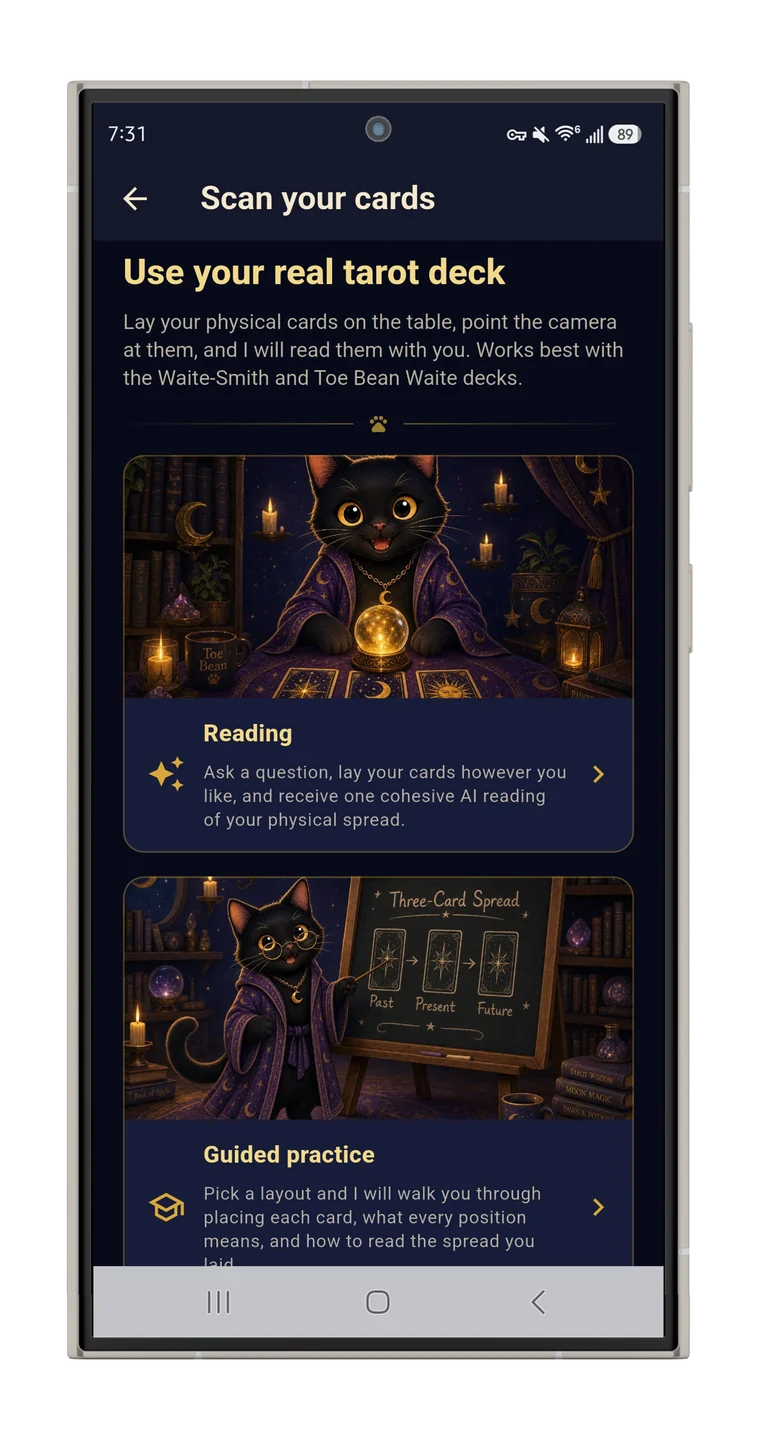
Walking the ten positions is the thing the Toe Bean Tarot app does for you. The Celtic Cross is one of its built-in spreads, and if you're using a paper deck, guided practice shows an animated diagram of where each card goes, including turning the Challenge card sideways, then reads the finished layout as one story. It's on Google Play.
Quick answers
What is the Celtic Cross tarot spread?
A ten-card layout in two parts: a cross of six cards covering the situation and its timeline, and a staff of four cards running from you outward to the likely outcome.
Is the Celtic Cross good for beginners?
It's readable in your first few months if you take it in chunks, but save it for questions that genuinely have many moving parts. A three-card spread handles most things.
Which card is the challenge card?
Card two, laid sideways across card one. It shows what crosses you: the obstacle, the tension, or sometimes the help you're resisting.
Does the outcome card mean it's decided?
No. The outcome position shows where things are heading if nothing changes, which is exactly the information you'd want in order to change something.