
Articles · Lessons
Learning Tarot with an App vs. Books vs. Courses
Learning tarot with an app, a stack of books, or a course all work. They just solve different problems, and the honest comparison is shorter than the arguments about it.
Apps: habit, structure, practice on tap
Apps are unbeatable at the things beginners struggle with most: showing up daily, learning in the right order, and getting repetition without boredom. A good one hands you a daily card, sequenced lessons, quizzes, and spaced review, and it lives in the pocket you already check.
The catch: quality varies wildly. Plenty of tarot apps are a meanings list with ads. If an app can't teach, it's a reference, not a teacher. We compared the good ones honestly in the best tarot apps in 2026.
Books: depth and a voice
Books go deeper than any app screen: symbolism, history, a whole author's philosophy of reading. The weakness is that a book can't schedule you, quiz you, or notice you stopped. It's easy to read three tarot books and never draw a card.
Courses: feedback and company
A course (or a workshop, or a study circle) adds the two things self-study can't: someone correcting you and people expecting you to show up. Costs more, moves at the group's pace, and quality depends entirely on the teacher.
The combination that works
- An app for the daily habit, the sequence, and the review.
- One good book for depth once the basics stick.
- Other readers (a friend, a forum, a circle) for feedback when you're ready.
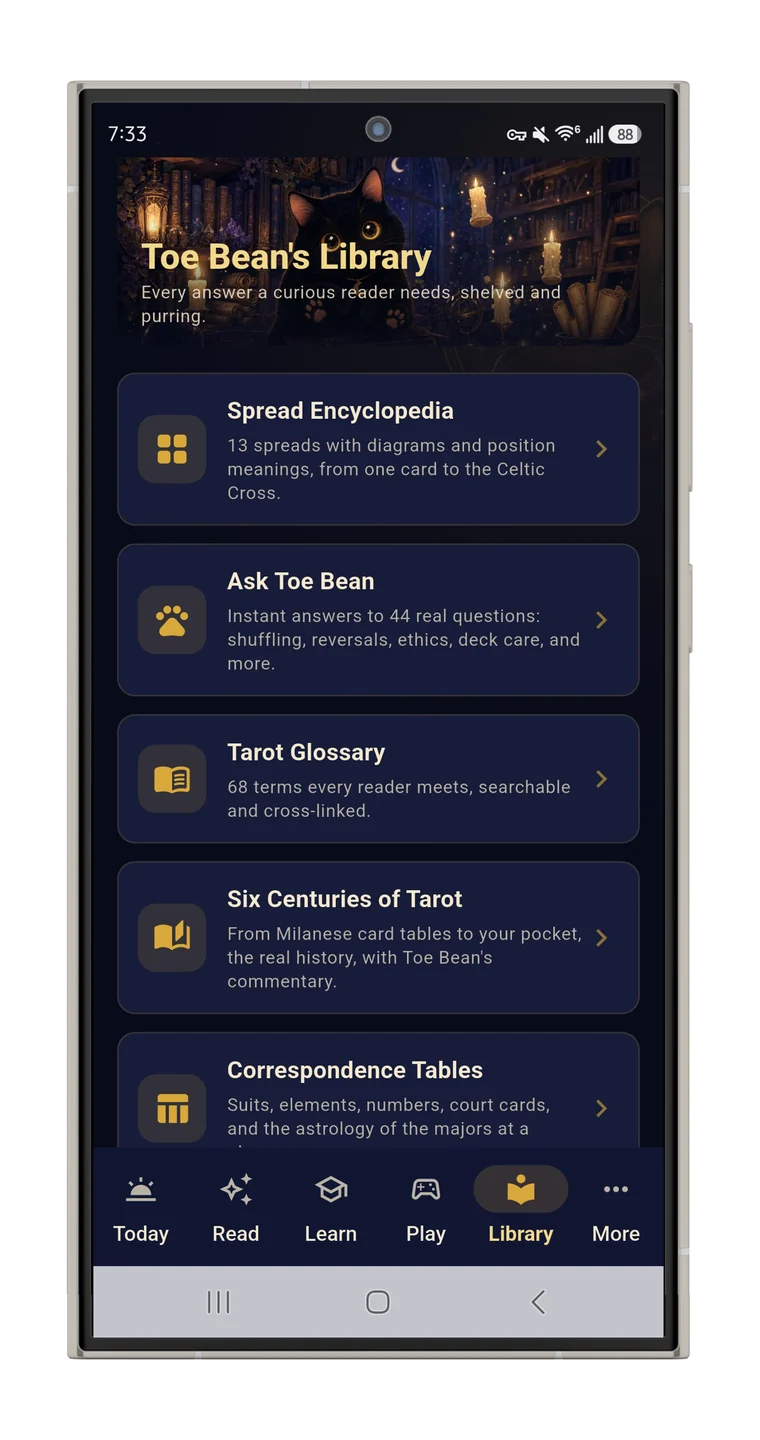
Full disclosure: we're biased, because we built the app half of this. The Toe Bean Tarot app is a complete guided curriculum with games, spaced review, and an offline reference library; the deep-dive books, you'll pick yourself.
Whichever format you choose, the method underneath doesn't change: here's the best way to learn as a beginner, and the full roadmap if you're starting from zero. The memory work is the same everywhere too: all 78 meanings, without misery.