Articles · Culture
Is Tarot a Religion? Is It Witchcraft? A Calm Guide for the Curious
Is tarot a religion? No. Tarot has no deity, no doctrine, no scripture, no clergy, no membership, and no beliefs you have to sign up for. It's a deck of 78 cards and a set of practices people layer on top of them. Is it witchcraft? Also no, though some witches use it, and we'll get to why the two get mixed up. If you're curious but a little nervous, or you come from a faith that has opinions on this, here's the calm version.
Where tarot came from (a card game)
Tarot began as a card game in 1400s Italy and stayed a game for about three centuries. The mystical layer was added from 1781 onward, first by French writers and later by British occultists in the late 1800s. So the cards are older than every belief attached to them. The full story is in our brief, true history of tarot, and it's more ordinary than most people expect.
Is tarot witchcraft?
No. Some modern witches use tarot as one tool among many, which is where the idea comes from. But using tarot doesn't make someone a witch any more than owning a chessboard makes someone a grandmaster. People of many faiths and of none read tarot: Christians, Jews, Buddhists, Pagans, Wiccans, atheists. Nothing in the practice requires believing in spirits, summoning anything, or "opening doors." The cards are printed cardstock.
So what is it, then?
What most modern readers describe is closer to journaling with pictures. You draw a card, it hands you a theme (patience, an ending, a hard truth, a fresh start), you notice what it stirs up, and you write it down. The card doesn't know your life. You do. That's why readings can feel so on point, and the psychology behind it is laid out in why tarot readings feel accurate. If you want to try the reflective version, reading tarot for yourself walks you through it.
Prediction or reflection: you pick the frame
Some readers do treat tarot as fortune-telling. Many don't. Nothing about the deck forces either frame; you choose. If the predictive version makes you uneasy, you can leave it on the shelf and still get everything the reflective version offers. For what it's worth, our Android app is built around the reflective frame: its Warm, Practical, and Mystical guides offer supportive interpretations rather than predictions.
What religious traditions say
Some traditions do object, and it's only fair to say so plainly. The Catechism of the Catholic Church (paragraph 2116) rejects all forms of divination, and many Protestant, Jewish, and Muslim teachers say similar things. If your tradition forbids divination, that's worth taking seriously. The open question is whether reflective tarot (using the cards as prompts to think about your own life) counts as divination for you. That's between you and your conscience, your community, or your clergy. We won't tell you what to conclude, and you should be wary of anyone who does.
About that Devil card
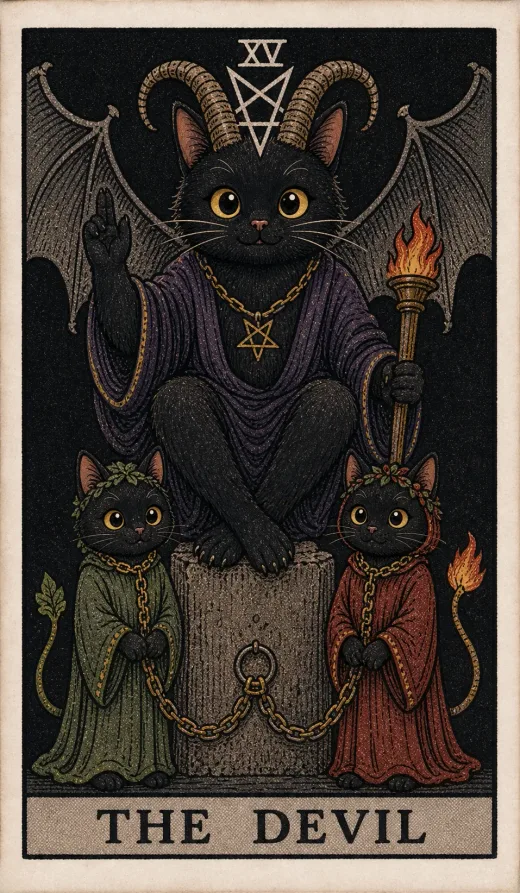
The card that alarms people most is The Devil: a horned figure with two chained figures below it. Its traditional meaning is bondage and material temptation, the habits, fears, and attachments that hold us, and the chains are drawn loose on purpose. It's not an invitation to worship anything. The full reading is in our Devil card meaning.
How to decide for yourself
- Name what you'd be doing. Drawing a card and journaling about it is different from asking the deck who you'll marry. Be honest about which one it is.
- Check it against your tradition. If you're unsure, ask someone in it you trust.
- Start small, if you start at all. One card, a few sentences, no ceremony required.
- Notice how it leaves you. Calmer and clearer tells you something. Anxious tells you something too.
Tarot is having a moment (we look at why tarot is popular right now) partly because it fits this quieter, reflective use. Whether it fits you is yours to decide, and no one else's.