Articles · Culture
Black Cats and Tarot: A Short History of an Iconic Pairing
Black cats and tarot ended up together because they walked the same road. Each started out ordinary (a pet, a card game), got dressed up in borrowed mystery, was feared for a while, and was then welcomed back as something cozy. Here's the short version.
Cats had a good reputation first
Ancient Egypt revered cats. They were linked to the goddess Bastet, and killing one was a serious crime. For a long stretch of history, a cat in the house was a blessing, not an omen. Hold that thought; Egypt comes back.
Where the spooky version came from
In 1233, Pope Gregory IX issued a bull called Vox in Rama. It described a supposed heretical rite that involved a black cat, and historians usually point to it as the moment Europe started tying black cats to the devil.
The idea hardened during the witch trials of the 1400s to 1600s. English trials in particular featured "familiars," animal companions accused of serving witches. A 1566 trial in Chelmsford involved a cat named Sathan. Cats weren't the only familiars (toads and dogs turn up in the records too), but the cat is the one that stuck in the popular imagination. Toads make poor mascots.
Superstition never settled on one answer. In the UK and Japan, a black cat crossing your path is often taken as lucky. In the US and much of Europe, the same cat is called unlucky. Sailors' families kept black cats for luck. Same animal, different neighborhood.
Tarot took the same detour
Tarot started as a card game in 1400s Italy, played for tricks, not truth (the full story is in our history of tarot). Then in 1781 the French writer Antoine Court de Gébelin claimed tarot was secret Egyptian wisdom. It wasn't, but the idea stuck.
So both cats and tarot were handed a mystical Egyptian past: one earned, one invented. That borrowed mystery is also part of why people still ask whether tarot is a religion or witchcraft.
Paris in the 1880s: cats and cards share a scene
In 1881 a cabaret called Le Chat Noir opened in Paris. Théophile Steinlen's black-cat poster for it, from 1896, is one of the most famous images of the era; you've seen it on a dorm room wall. The same city, in the same decades, hosted the French occult revival that turned tarot into a mystical tool: Éliphas Lévi's writing in the 1850s, then Papus's "Tarot of the Bohemians" in 1889. The black cat became a symbol of bohemian nightlife while tarot became a symbol of hidden knowledge, a few streets apart.
1909: the most-seen black cat in tarot
Then came the Rider-Waite-Smith deck. Artist Pamela Colman Smith put a black cat at the feet of the Queen of Wands, and because that deck became the template for most decks since, that one small cat is probably the most-seen black cat in tarot. It suits the card: the Queen of Wands stands for warm, magnetic confidence and natural charm, and the cat at her feet is the one creature in the picture that looks completely unbothered.
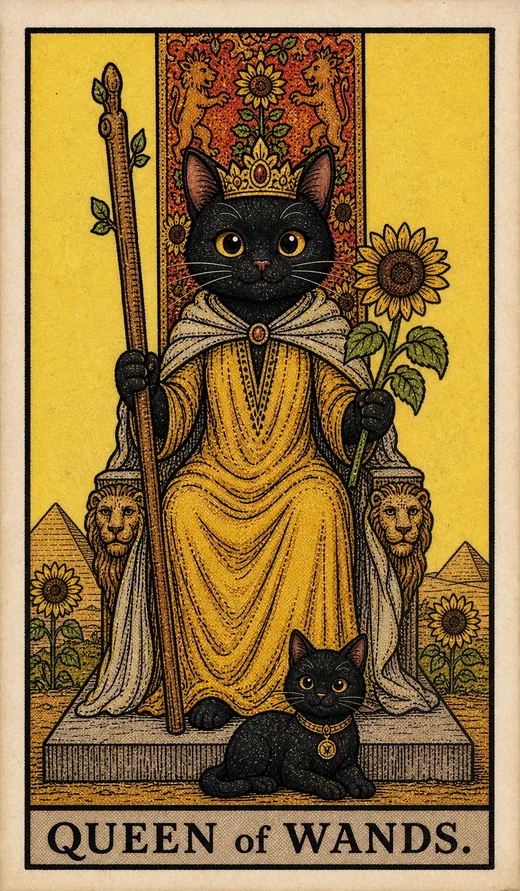
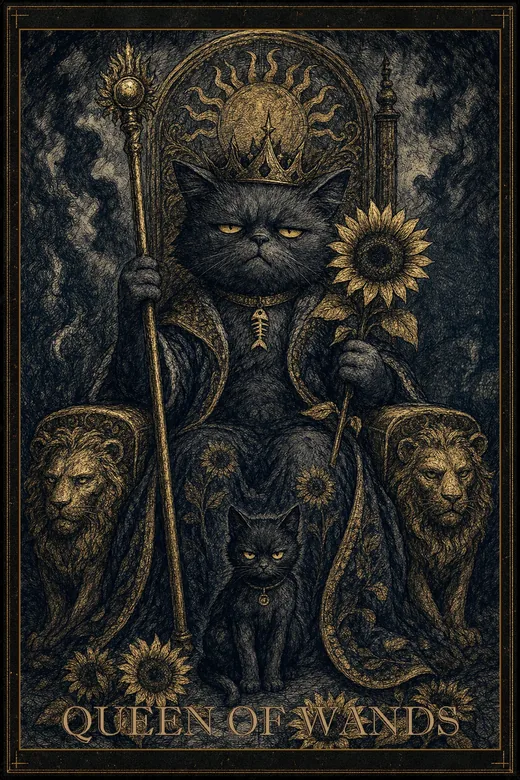
In our Toe Bean deck, an homage to Smith's designs with cats in every role, the Queen of Wands is herself a black cat in a gold robe, with a smaller black cat still sitting at her feet. Two black cats for the price of one. The Salty Bean deck has its own etched ink and gold take, with a queen who looks like she'd rather you hadn't come. Both decks, all 78 cards each, live in the Toe Bean Tarot app (Android only).
The reclaiming
Both stories end the same way. Tarot went from feared fortune-telling to a reflection habit people learn like any other craft and keep next to their journal. Black cats went from familiar to family. One wrinkle remains: shelter workers often say black cats wait longer to be adopted than other cats. They photograph poorly, and the old superstitions haven't fully worn off. If you're at a shelter and a black cat is watching you, that's your sign.
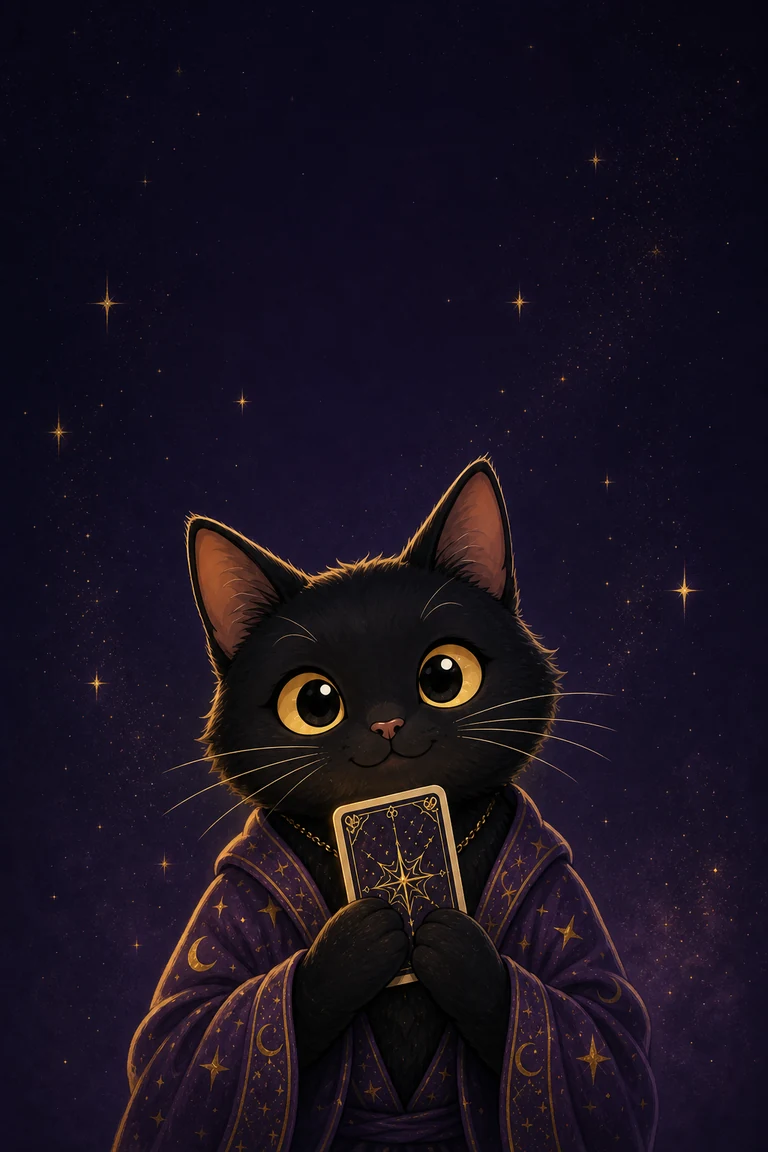
Our mascot, Toe Bean, is a small black cat with big gold eyes, holding a card. We didn't pick that to be spooky. We picked it because, after eight centuries of bad press, a black cat holding a tarot card is about the coziest picture we could think of.